Sunday, March 25, 2018

SHORTIA GALACIFOLIA 

OCONEE BELLS


Most botanist know the legendary story of Shortia galacifolia, or Oconee Bells. The plant was originally discovered and collected in 1788 by French botanist Andre Michaux. His unnamed specimen was stored in a French herbarium until it was noticed by the American botanist Asa Gray in 1839. Asa named the plant for another American botanist, Charles W. Short. When Asa Gray returned to the states he was determined to find the beautiful Oconee Bell plant. However, his main clue, “in the high mountains of Carolina”, turned out to be very misleading. Asa and many other botanists searched high mountain peaks, such as Roan Mountain, Grandfather Mountain and Mt. Mitchell, for years with no luck. Forty years later in 1877, a 17-year-old lad named George Hyams found the plants growing along the Catawba River near Marion, North Carolina. Eventually, word got back to Asa Gray that the plant had been rediscovered. The ecstatic Gray met with George Hyams and finally saw the elusive plant in person but he died never seeing the plant in bloom. Gray requested that his grave in Cambridge, Massachusetts be covered in Oconee Bells.

American Botanist  - Asa Gray (1870's)
Photographer Unknown; Public Domain


The genus Shortia is within the family Diapensiaceae. There are only five species known worldwide. All five species are mountainous and relatively rare in occurrence. Four species are in Asia and the fifth species is endemic to the Southern Appalachian Mountains of the eastern United States.  The American species has two variations; Shortia galacifolia Torrey and Gray var. galacifolia and S. galacifolia Torrey and Gray var. brevistyla Davies. 

Both variations are found within North Carolina and grow along the moist banks and slopes of streams in heavy shade created by Rhododendron shrubs.  There is often a clear transition between Shortia and Galax urceolata plants as one moves up slope from a stream. Shortia is on the lower, moister, more heavily shaded parts of the slope. As one moves up the slope, away from the stream, into the dryer and less shaded higher areas it is replaced by Galax, which also happens to be a member of the family Diapensiaceae. Shortia’s specific epithet “galacifolia” is due to the resemblance of Shortia’s leaves to those of its cousin Galax. Both have clustered, shiny, rounded leaves with serrated to crenate margins. The leaves of both species can also look reddish or bronzed. However, if you look closely, Shortia’s leaves are pinnately veined while the leaves of Galax are palmately veined.


Shortia galacifolia leaf, note the pinnate veination.

Galax urceolata leaves, note the palmate veination.

Shortia galacifolia Torrey and Gray var. galacifolia was the original species found by Michaux. It is often referred to as Southern Shortia. The original collection site was destroyed and flooded by the creation of Lake Jocassee. However, wild populations still exist in Jackson and Transylvania Counties in N.C., Oconee and Pickens Counties in South Carolina, and Rabun County in Georgia. The best place to see Oconee Bells is along the Oconee Bell Nature Trail at Devils Fork State Park in South Carolina. The plants bloom early in the spring from mid-March to April.
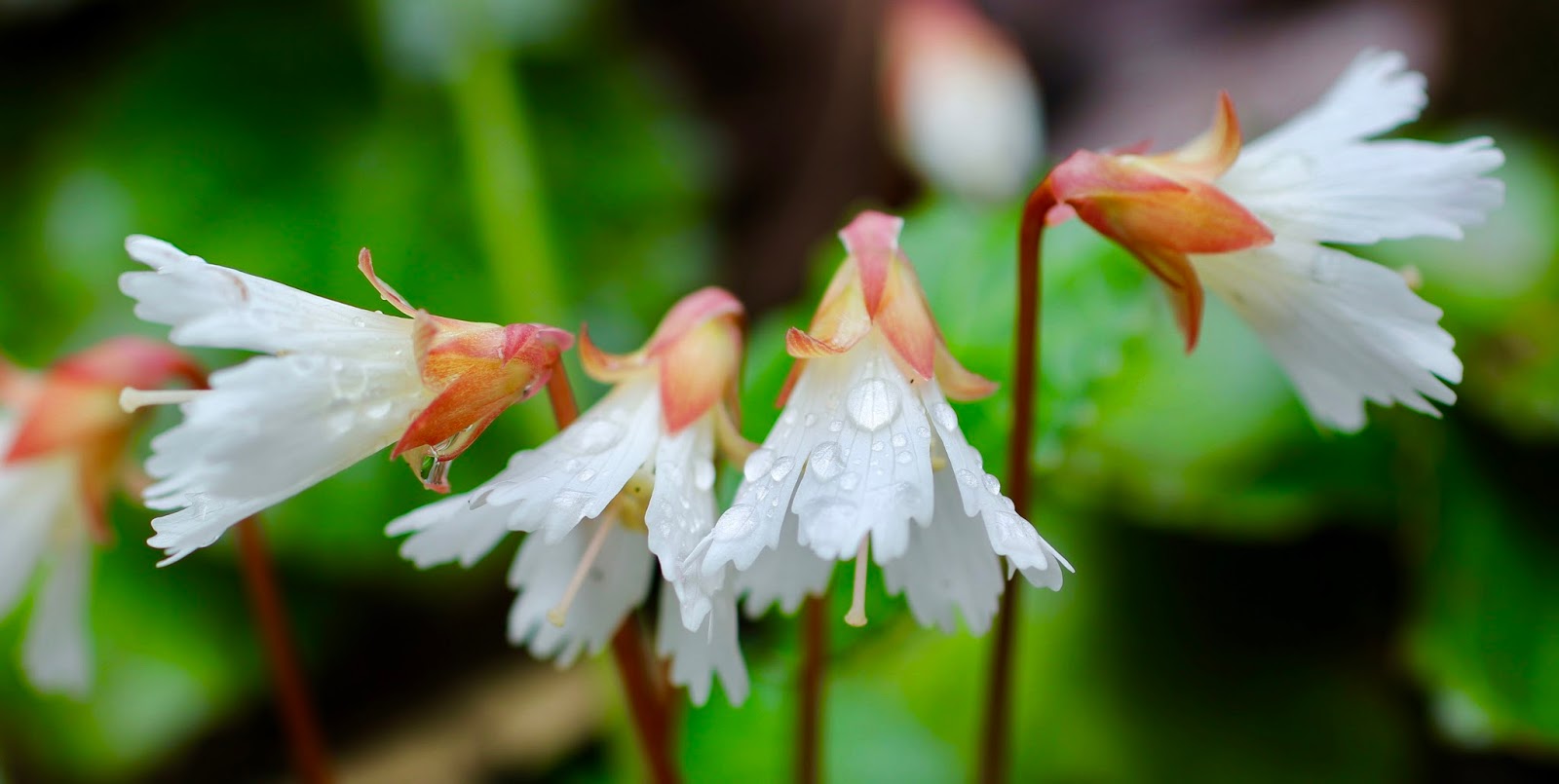


Shortia galacifolia Torrey and Gray var. galacifolia Photos taken at Devils Fork State Park along the Oconee Bell Nature Trail


Shortia galacifolia Torrey and Gray var. galacifolia or Southern Shortia


Shortia galacifolia Torrey and Gray var. galacifolia, showing the typical growth habit of the species.


S. galacifolia Torrey and Gray var. brevistyla Davies is only found in McDowell County, N.C. It is often called Northern Shortia. The sites are protected and closed to the public. As its specific epithet implies it has a shorter style than S. galacifolia var. galacifolia. Northern Shortia has styles 6-10mm while the Southern Shortia has styles 12-18 mm in length. Also, per Flora of North America, Northern Shortia has shorter corolla lobes, 14-17mm, and Southern Shortia has corolla lobe 16-25 mm in length.


S. galacifolia Torrey and Gray var. brevistyla Davies,
or Northern Shortia, at a protected site in McDowell County, N.C.
Close up of a Northern Shortia flower with its shorter corolla
lobes and stigma relative to the Southern Shortia variation.

Northern Shortia

Side view of opening Northern Shortia flower.

Nice cluster of Northern Shortia flowers at undisclosed McDowell County site.


Clemson naturalist Patrick McMillan once said, “So Oconee Bells was found by a man who didn’t name it. It was named for a man who never saw it, by a man who couldn’t find it!”


References:

1. Radford, Albert Ernest, Harry E. Ahles, and Clyde Ritchie Bell. Manual of the Vascular Flora of the Carolinas. Chapel Hill, NC: U of North Carolina Press, 1983. Print.

2. Weakley, Alan S. Flora of the Southern and Mid-Atlantic States. Chapel Hill, NC: U of North Carolina Herbarium, North Carolina Botanical Garden, U of North Carolina, Chapel Hill, 2015. Print.

3. Flora of North America Editorial Committee, eds.  1993+.  Flora of North America North of Mexico.  20+ vols.  New York and Oxford. Print.

4. Wildflowers of the United States. (n.d.). Retrieved March 25, 2018, from http://uswildflowers.com/detail.php?SName=Shortia galacifolia.

5. S. (2011, February 24). O is for Oconee Bells. Retrieved March 25, 2018, from https://www.youtube.com/watch?v=QTxtvAXSW1A

6. All photographs are taken by and are the property of Tracie Jeffries unless otherwise noted.


Sunday, November 5, 2017

NORTH CAROLINA’S GRASS–OF-PARNASSUS SPECIES


NORTH CAROLINA’S 

GRASS–OF-PARNASSUS SPECIES


Figure 1: Parnassia asarifolia the Kidney-leaved Grass-of-Parnassus


Grass-of-Parnassus or Bog Stars species are favorites of many people due to the intricate and contrasting green veining on the white petals. There are approximately seventy species worldwide and nine species in North America1. Parnassia are found through-out the Northern Hemisphere in moist habitats ranging from alpine meadows, fens, bogs, seeps, and swamps.  North Carolina is lucky to have three species of Parnassia; P. asarifolia the Kidney-leaved Grass-of-Parnassus, P. grandifolia the Bigleaf Grass-of-Parnassus, and P. caroliniana the Carolina or Savanna Grass-of-Parnassus.


Table 1: Summary of characteristics of North Carolina Parnassia species.


Parnassia asarifolia
Kidney-leaved Grass-of-Parnassus


Parnassia grandifolia
Bigleaf Grass-of-Parnassus

Parnassia caroliniana
Carolina Grass-of-Parnassus
Basal leaves basically reniform to orbiculate with cordate bases, often wider than long
Basal leaves ovate,
leaf bases rounded to subcordate, longer than wide
Basal leaves broadly ovate, leaf bases rounded to subcordate
Ovary white - greenish
Ovary green sometimes whitish at base
Ovary white
Petals are clawed
Petals not clawed
Petals not clawed

Each petal has 11-15 major parallel veins2
Each petal has 5-9 major parallel veins3
Each petal has 11-17 major parallel veins3
5 – three-lobed staminodes

Staminodia shorter than stamens ( be careful of this trait – check mature flowers)
Staminodia longer than stamens
Staminodia shorter than stamens
Prefers moist acidic environments
Prefers moist more basic, calcareous environments


Parnassia asarifolia or the Kidney-leaved Grass-of-Parnassus is uncommon in North Carolina but, is probably the most commonly seen species in our state. It is restricted to the mountains and is sometimes referred to as the Appalachian Grass-of-Parnassus. As the name implies it has a basal rosette of reniform-orbiculate leaves with cordate bases (Figures 2, 3). The flowers have five sepals and five clawed white petals with the typical intricate green veining (Figures 4, 5, 6, 7, 8). To me this is our most beautiful species because the petals have undulating margins. The gynoecium (female reproductive structures) has a superior, four connate carpellated ovary with a short style and four stigmas.  The androecium (male reproductive structures) is composed of five stamens and five sterile nectariferous staminodes. The staminodia are deeply three lobed and give the impression there are fifteen (Figures 4, 5, 6).  This species blooms in late fall and can be seen at high elevation roadside seeps along the Blue Ridge Parkway. 

Figure 2: Basal rosette of Parnassia asarifolia or Kidney-leaved Grass-of-Parnassus leaves showing the reniform-orbiculate leaves with cordate bases. Notice most leaves are wider than long.


Figure 3: Kidney-leaved Grass-of-Parnassus leaf showing the strong cordate base.
Figure 4: Flower morphology of Parnassia asarifolia. Notice the clawed petals, this feature is not found in P. grandifolia and P. caroliniana. Also, notice the stamen longer than the staminodia, another feature unique (among the N.C. species) to P. asarifolia.


Figure 5: A close-up of a Parnassia asarifolia petal showing the intricate green veining. P. asarifolia has 11-15 major parallel veins per petal. Also note the deeply three-lobed staminode (center) and how it is shorter than the stamen.


Figure 6: Kidney-leaved Grass-of-Parnassus, Parnassia asarifolia, flower. Notice the five stamen and the sterile staminodia.

Figure 7: Kidney-leaved Grass-of-Parnassus, Parnassia asarifolia, flower and bud.

Figure 8: Drawing of Parnassia asarifolia, Kidney-leaved Grass-of-Parnassus.
USDA-NRCS PLANTS Database / Britton, N.L., and A. Brown. 1913. An illustrated flora of the northern United States, Canada and the British Possessions. 3 vols. Charles Scribner's Sons, New York. Vol. 2: 212.

Figure 9: Flowers of Kidney-leaved Grass-of-Parnassus, Parnassia asarifolia. Notice that these are freshly opened flowers and the stamen have not elongated yet and appear shorter than the staminodia.


The Bigleaf Grass-of-Parnassus, Parnassia grandifolia, is rare and rated as threatened in North Carolina and federally is listed as a species of special concern. It can be found in both the mountains and in several coastal counties. Along the coast it often grows in concurrence with P. caroliniana. Although P. grandifolia and P. caroliniana have many characteristics in common the former can be distinguished by having a green ovary rather than white, and by having fewer major veins on the petals, (5-9 veins in P. grandifolia verses 11-17 in P caroliniana) (Table 1)(Figures 10, 11, 12, 14). In the mountains it is found primarily in fens and seepages over mafic or calcareous rock. Bigleaf Grass-of-Parnassus can be separated from P. asarifolia by its dark green ovary, lack of clawed petals, leaves that are longer than wide (Figure 13), staminodia longer than the stamens, and more narrow petals with fewer green veins (5-9 veins in P. grandifolia versus 11-15 in P, asarifolia) (Table 1).

Figure 10: A drawing of  Bigleaf Grass-of-Parnassus, Parnassia grandifolia. USDA-NRCS PLANTS Database / Britton, N.L., and A. Brown. 1913. An illustrated flora of the northern United States, Canada and the British Possessions. 3 vols. Charles Scribner's Sons, New York. Vol. 2: 212.

Figure 11: A close-up of a Bigleaf Grass-of-Parnassus, Parnassia grandifolia, flower showing the green ovary, staminodia longer than the stamen, and 5-9 major parallel green veins on each petal.


Figure 12. A close-up of a Bigleaf Grass-of-Parnassus, Parnassia grandifolia, petal showing the beautiful and intricate green veining.


Figure 13: Ovate leaves of Bigleaf Grass-of-Parnassus, Parnassia grandifolia.  Notice they are longer than wide.


Figure 14: Bigleaf Grass-of-Parnassus, Parnassia grandifolia, flower.


Parnassia caroliniana, Carolina Grass-of-Parnassus, is endangered in North Carolina. The specific epithet, “caroliniana’, is very apt since this species is primarily found in North and South Carolina with a disjunct population in the Florida Panhandle. It grows in a few of our more southern coastal counties in seepage areas, bogs, and wet pine or cypress savannas often underlain with coquina limestone3. The latter plant communities have been greatly reduced due to draining, the lumber industry, and development. They are also fire dependent and without regular prescribed fire burns many of our rare coastal plants such as Venus flytrap (Dionaea muscipula), Rough-leaved Loosestrife (Lysimachia asperulifolia), Carolina Grass-of-Parnassus (Parnassia caroliniana), Sandhills Lily (Lilium pyrophilum), Pixie-moss (Pyxidanthera brevifolia) and the Pine Barren Gentian (Gentiana autumnalis) would cease to exist in North Carolina. The Carolina Grass-of-Parnassus blooms in late summer and fall. My photographs of the plant blooming were taken in mid-November (Figures 15, 16,  17, 18, 19). Even though this is the rarest of our three species I find it to be the least eye-catching. 

Figure 15: Carolina Grass-of-Parnassus, Parnassia caroliniana, flower showing a nice view of the five deeply three-lobed staminodia.


Figure 16: A close-up of a Carolina Grass-of-Parnassus, Parnassia caroliniana, flower petal showing the 11-17 major parallel green veins.


Figure 17: Carolina Grass-of-Parnassus, Parnassia caroliniana, flower, note the white ovary.


Figure 18: Carolina Grass-of-Parnassus, Parnassia caroliniana, leaves.


Figure 19. Carolina Grass-of-Parnassus, Parnassia caroliniana, flower in bud.


I hope you have enjoyed learning about our state Parnassia species. The future of these beautiful species and other rare species in North Carolina depends on various conservation efforts. If you enjoy and value North Carolina’s unique flora and fauna please consider joining and supporting some of the organizations listed below. 


Audubon Society in North Carolina  http://nc.audubon.org/
Friends of Plant Conservation   https://www.ncplantfriends.org/
North Carolina Native Plant Society  http://www.ncwildflower.org/
North Carolina Natural Heritage Program  https://www.ncnhp.org/
North Carolina Sandhills Conservation Partnership  http://www.ncscp.org/
Southern Appalachian Highlands Conservancy  https://appalachian.org/
The Nature Conservancy in North Carolina  https://www.nature.org/ourinitiatives/regions/northamerica/unitedstates/northcarolina/index.htm


“Unless someone like you cares a whole awful lot,
Nothing is going to get better. It's not.”


Resources:

1. Ball, Peter W. “Parnassia.” Parnassia in Flora of North America @ Efloras.org, www.efloras.org/florataxon.aspx?flora_id=1&taxon_id=124074. 


2. Radford, Albert Ernest, Harry E. Ahles, and Clyde Ritchie Bell. Manual of the Vascular Flora of the Carolinas. Chapel Hill, NC: U of North Carolina Press, 1983. Print.


3. Weakley, Alan S. Flora of the Southern and Mid-Atlantic States. Chapel Hill, NC: U of North Carolina Herbarium, North Carolina Botanical Garden, U of North Carolina, Chapel Hill, 2015. Print.


4. Phillips, R. B. 1980. Systematics of Parnassia L. (Parnassiaceae): Generic Overview and Revision of North American Taxa. Ph.D. dissertation. University of California, Berkeley.


5. “Parnassia caroliniana.” Results Detailed Report, explorer.natureserve.org/servlet/NatureServe?searchName=Parnassia%2Bcaroliniana. 


6. All photos, unless otherwise noted, were taken and are property of Tracie Jeffries.